

(And Why Most Businesses Do Not Realize They Need One Until It Is Too Late)
If you work in any kind of business that deals with customers, you have probably heard someone say:
“We need a CRM”
They say it confidently. As if everyone in the room knows exactly what that means.
But here is the quiet truth.
Most teams adopt a CRM long before they truly understand what it is supposed to do.
So instead of starting with a textbook definition, let’s explain it the way it usually becomes clear in real life. After something breaks.
What is a CRM?
A CRM, or Customer Relationship Management system, is the place where a company stores and manages everything it knows about its customers.
That includes names and contact details, but it goes far beyond that. A CRM keeps track of conversations, commitments, deals, support issues, and what should happen next in the relationship.
In simple terms, a CRM is a company’s memory about its customers.
Everything else you hear about CRMs, including automation, dashboards, analytics, and AI, exists to support that one core job.
Because once a business grows beyond a small team, human memory stops being reliable.
The Moment That Explains Why CRMs Exist
A customer emails.
They are frustrated.
They reference a conversation from three weeks ago. A promise someone made. A follow-up that never happened.
- You search your inbox.
- You check Slack.
- You ask around.
That moment explains exactly what a CRM is for.
It is not about software.
It is about preventing confusion, missed promises, and broken trust.
Why Spreadsheets and Shared Inboxes Always Fail
Most companies do not start with a CRM.
They start with:
- Spreadsheets
- Shared inboxes
- Personal notes
- Good intentions
That works for a while.
Then growth introduces friction:
- A salesperson goes on vacation and a deal stalls
- A follow-up is forgotten
- A new hire has no idea who the top customers are
- Leadership asks for pipeline numbers and no one trusts the answer
None of this feels dramatic at first. It just feels messy.
Eventually, you realize something uncomfortable:
You do not have a system.
You have a collection of disconnected conversations.
CRMs were created to solve exactly that problem.
What a CRM Actually Does in Practice
Forget the marketing language. In day-to-day work, a CRM does a few essential things.
1. It centralizes customer information
All customer data lives in one place, including contact details, emails, calls, notes, deals, and support history. When someone leaves the company, that knowledge does not disappear.
2. It shows the full customer history
Anyone can see past conversations and interactions, which means customers do not have to repeat themselves and teams stay aligned.
3. It helps sales teams manage deals
Sales representatives can see deal stages, next steps, and follow-ups without relying on memory or scattered reminders.
4. It gives marketing real context
Marketing teams can segment audiences based on behaviour and history instead of guessing. Messages become more relevant and timely.
5. It improves customer service
Support teams instantly see who the customer is, what they bought, and any past issues. Problems get resolved faster and with less frustration.
6. It gives leadership visibility
CRMs provide accurate insights into pipelines, performance, trends, and forecasting. Decisions are based on data instead of optimism.
The Main Types of CRM Software
Most modern CRM platforms combine all of these, but traditionally there are three types.
Operational CRM
Focuses on daily activities like lead management, sales tracking, and customer support.
Analytical CRM
Uses customer data to identify patterns, forecast revenue, analyze churn, and support decision-making.
Collaborative CRM
Ensures teams share the same customer information across sales, marketing, support, and other departments.
Customers experience one company, not separate teams. A CRM helps the business operate the same way.
Why Growing Businesses Eventually Need a CRM
Companies do not adopt CRMs because they enjoy implementing new tools.
They adopt them because:
- Leads fall through the cracks
- Customers get inconsistent answers
- Teams stop sharing information effectively
- Leadership cannot trust the numbers
- Personalization expectations outgrow spreadsheets
At a certain point, not having a CRM becomes a business risk.
And the longer a company waits, the harder the transition becomes.
What Modern CRMs Look Like Today
CRMs have evolved far beyond contact databases.
Many now include:
- Email marketing and automation
- Sales pipeline and deal management
- Customer support and ticketing
- Workflow automation
- Reporting and revenue forecasting
- AI-driven recommendations
- Integrations with other business tools
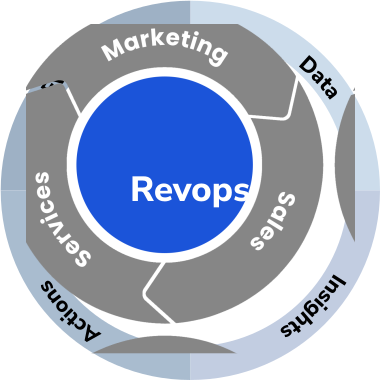
In many organizations, the CRM becomes the central system that connects sales, marketing, customer success, and service.
The Most Useful Way to Think About a CRM
If you strip everything away, a CRM comes down to one idea:
A business succeeds when it remembers the people it serves accurately, consistently, and across the entire team.
A CRM is how that memory scales.
It helps teams follow up reliably, communicate clearly, and act with context instead of assumptions.
Most importantly, it allows customers to feel like they are dealing with one organized company, not a series of disconnected conversations.
One Honest Final Thought
If you are managing customers across multiple tools, a few spreadsheets, and people’s heads, you do not have flexibility.
You have fragility.
A CRM will not fix a bad strategy.
But it will prevent good intentions from falling apart.
That is why almost every growing business eventually reaches the same conclusion:
We need a CRM.
The only question is whether you reach it before or after trust starts leaking out of the system.